Blue, as wintry women swimming invisible
one ghostly curtain and a herd of thunder
degrees cooler than a nail in September
pause
quince backward into the light
the behavior of teeth is balsamic glittering
sprouts wings
the future waits unexpected, your eyes are
starlings kisses
anthologize for the sake of bells, among bees
tansy carrot, the absolute formula for
delirium gives a distant lust
at the end of a dark pier
not of stone, our tongues are on
form your hands into afternoons
gulp the liquid waiting
there and hear
me barely
breathing.
Friday, January 26, 2007


Thursday, January 25, 2007

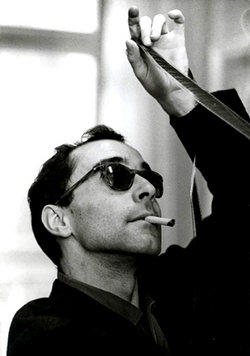
I still haven't seen "Babel" with supporting actress nominee Rinko Kikuchi. The Oscar buzz is
"Will the long-overlooked Martin Scorsese finally win his Oscar this year? The nominations bring us a reprise of yet another faceoff between two great veteran directors, Clint Eastwood, who gets better as the years go by, whose "Letters From Iwo Jima" was nominated for best picture, director and original screenplay, and Scorsese, whose "The Departed" was nominated for best picture, director and adapted screenplay." --Roger Ebert
"Little Miss Sunshine" would fall apart like a house of cards without Alan Arkin's outstanding performance. Otherwise, it's not Oscar-worthy. I doubt I'll see Eastwood's latest. There's an element of what he does that reminds me of Ron Howard's films. I don't need everything tied up like a neat little package for me and I know life is sad. Eastwood is too literal-minded for me. He's not making magic or myth. Scorsese does this routinely. In fact I think he subconsciously has attempted the blockbuster against his better judgment a time or two (think "Casino," blech). By the way, I love Cate Blanchett.

David Lynch will be downtown tomorrow pushing his new book and I'll probably head down to catch a glimpse of him. My favorite directors, tho, will always be Fellini, Truffaut, Godard, Kurosawa, and yes, George Lucas. I remember when I saw "Star Wars" for the first time and walked out into the parking lot afterward--it made me look up at the sky and really think differently for a moment about the possibilities. There hasn't been too many films that have made me really step back for a minute in awe. "Citizen Kane" grew on me slowly, but it is the most amazing film America has produced I think. "The Wizard of Oz" is legendary for its mythmaking iconography. Did I mention that I love Cate Blanchett? "Rebel Without a Cause" is a case study in teenage isolation. There's a unique quality to James Dean's performance because he isn't really acting. I think Sofia Coppola may be the director to watch in the near future. "Lost in Translation" is eminently watchable. And now that Woody Allen is MIA, who's going to define our particular brand of American neurosis? The Coen brothers have taken shots at it, but some of their attempts, although hilarious, (Lebowski, Raising Arizona) are a bit like cartoons on a certain level. Hands down, the worst director is still Paul Verhoeven...I'm still chuckling that someone had the idea to put out a "V.I.P. Edition" of "Showgirls."

At Midnight Down by the Docks
Four days
since the needles
inside the man's lungs
pierced his chest lining entirely
like tiny anemones.
This released a hurricane.
His skeleton
has become
a brittle leaf
after the whole house burned down
in a frontpage fire.
But after all, his feet are
merely huge elephants, nearly extinct.
Upon a bed of overwork, he wears
an underpaid sweater
because the heat has been turned off
by
millionaire hyenas.
However, there is a
banana on his table that
also serves as his well-being.
The typewriter sprouted
wings and ordered him to sing
a song about a beautiful woman.
Tomorrow, more bad weather
followed by a cardiac arrest,
as the police arrive,
wearing human leather.
since the needles
inside the man's lungs
pierced his chest lining entirely
like tiny anemones.
This released a hurricane.
His skeleton
has become
a brittle leaf
after the whole house burned down
in a frontpage fire.
But after all, his feet are
merely huge elephants, nearly extinct.
Upon a bed of overwork, he wears
an underpaid sweater
because the heat has been turned off
by
millionaire hyenas.
However, there is a
banana on his table that
also serves as his well-being.
The typewriter sprouted
wings and ordered him to sing
a song about a beautiful woman.
Tomorrow, more bad weather
followed by a cardiac arrest,
as the police arrive,
wearing human leather.
Wednesday, January 24, 2007

Multiple-Choice Theater
In this world pure carnality is
not our best option, better to
keep your pretexts intact. Listen
my deepest humdrum charm,
so carelessly inspired, spins on
fatal ground. Launch unbridled
ardor, by verve else blank haystacks
she said, dust my bucket with
life or love. Thus, without pants
our reckless flight sans hope
fails to gossip in the howling gloom,
as grocers grope among lush
lentils, green envy gasps, grips her.
not our best option, better to
keep your pretexts intact. Listen
my deepest humdrum charm,
so carelessly inspired, spins on
fatal ground. Launch unbridled
ardor, by verve else blank haystacks
she said, dust my bucket with
life or love. Thus, without pants
our reckless flight sans hope
fails to gossip in the howling gloom,
as grocers grope among lush
lentils, green envy gasps, grips her.
Tuesday, January 23, 2007
Attention Grabbing Headline

Climate change isn’t a sexy issue, so it’s routinely put on the back burner. All of that is about to change as people realize that the detrimental effects of global warming will affect us all. Talk to someone you may know who isn’t aware of global warming and its negative effects. If skeptics aren’t made aware of the problem, valuable time will be lost. Future generations will wonder how we could have been so naive. Watch as global warming, as an issue, becomes depoliticized. Corporations such as BP, GE, AT&T, and others are now realizing that resistance to the facts will cost them consumer dollars. Smart companies will realize that the phenomenon of global warming will actually jumpstart new industries.
What will it take to counter the build-up of greenhouse gasses? 1. Education, 2. Action
Communities, one household at a time, need to consider their carbon footprint. Using the carbon footprint calculator is one way a household (or individual) can figure out the impact of their day-to-day activities on our environment.
Communities and individuals need to make their local, state, and Federal government aware that they are against initiatives that are bad for our environment. Large corporations are now aware that it’s in their best interest to promote ecological awareness— now. Irresponsible energy consumption, deforestation, activities such as strip mining, and our continued reliance on fossil fuels and plastics all contribute to the harm of our environment. Politicians need to become much more aware that depleted natural resources will cause calamity in our lifetimes. As populations fight over depleted natural resources, the world will slowly realize that climate change is not something happening in someone else’s backyard. It’s everyone’s problem.
You can do something about it. Find out how to become active on a local level. Initiatives are being implemented on a local level that you might not be aware of. Turn to the Internet to find out more about climate change and how to counteract it in your neighborhood. People are beginning to understand the importance of their own surroundings and how maintaining the ecosystem on a local level contributes to the well-being of the entire earth. Some initiatives, for example, use volunteers to clean up riparian zones. It can be as simple as picking up waste (many plastics found there are not biodegradable) and planting a few trees. Let the news media know about your efforts.
A “riparian zone” is the interface between land and a flowing surface water body. Plant communities along the river margins are called riparian vegetation, characterized by hydrophilic plants. Riparian zones are significant in ecology, environmental management and civil engineering due to their role in soil conservation, their biodiversity and the influence they have on aquatic ecosystems. Riparian zones occur in many forms including grassland, woodland, wetland or even non-vegetative. In some regions the terms riparian woodland, riparian forest, riparian buffer zone or riparian strip are used to characterize a riparian zone. The word "riparian" is derived from Latin ripa, meaning river bank.
Riparian zones may be natural or engineered for soil stabilization or restoration. These zones are important natural biofilters, protecting aquatic environments from excessive sedimentation, polluted surface runoff and erosion. They supply shelter and food for many aquatic animals and shade that is an important part of stream temperature regulation. When riparian zones are damaged by construction, agriculture or silviculture, biological restoration can take place, usually by human intervention in erosion control and revegetation. If the area adjacent to a watercourse has standing water or saturated soil for as long as a season, it is normally termed a wetland due to its hydric soil characteristics. Because of their prominent role in supporting a diversity of species, riparian zones are often the subject of national protection in a Biodiversity Action Plan.
Research shows riparian zones are instrumental in water quality improvement for both surface runoff and water flowing into streams through subsurface or groundwater flow. Particularly the attenuation of nitrate or denitrification of the nitrates from fertilizer in this buffer zone is important. Riparian zones can play a role in lowering nitrate contamination in surface runoff from agricultural fields, which runoff would otherwise have a negative effect on ecosystem and human health. The use of wetland riparian zones shows a particularly high rate of removal of nitrate entering a stream and thus has a place in agricultural management.
Get Green
Chicago is ONE of America's greenest cities. What does that mean? It means that Mayor Richard M. Daley has made a conscious effort to systematically plant trees, cut carbon dioxide emissions, and clean up waste. HAVE you noticed strange weather patterns recently? Global warming has become a fact of all of our lives. In the NEXT twenty years this will mean that cities along the EAST and west coasts will require new planning as water levels rise, changing weather patterns may cause droughts and also CAUSE increased precipitation that will affect crop growth resulting in food shortages. Adverse weather conditions may cause many to move to other parts of the country to maintain THEIR familiar standard of living. Worldwide THIS will mean that ecosystems at the north pole will undergo a process of extinction. Polar bears and penguins, migratory birds, fish, whales, and many plant species will die because of melting glaciers. Deserts worldwide will expand and BECOMEcompletely uninhabitable. As the population of the world increases exponentially, global warming presents a difficult challenge because the area of habitable land will continuously shrink. This will affect a nomad living in the Gobi desert the SAME way that it will affect a suburban mom living in Iowa. As this happens, the larger world population will scramble to control the finite amount of natural resources that we need to survive. That's why it's extremely important THAT we find alternative energy sources--now.
Culture
Soup spins a wild guitar in the stomach. That was Tuesday. Unless we open the can with a crustacean, soup boils little raspberries on the moon. My crouching cat naps after making magic soup. Just get me some red soup and a pile of cash.
Monday, January 22, 2007
Greil Marcus on American Folk
I live in Berkeley, California. Almost every day for nearly twenty years I’ve walked up the same steep, winding hill, up a stretch of pavement named Panoramic Way, which begins right behind the University of California football stadium. A few years back, when my fascination with Harry Smith’s Anthology of American Folk Music—a fascination that began around 1970—was turning into obsession, I began to imagine that Smith had lived on this street.
I knew that Smith was born in 1923 in Portland, Oregon, and grew up in and around Seattle, Washington; that as a teenager he had recorded the ceremonies and chants of local Indian tribes, and in 1940 had begun to collect commercially released blues and country 78s from the 1920s and 1930s. In 1952, in New York City, when his collection ran into the tens of thousands, he assembled eighty-four discs by mostly forgotten performers as an anthology he at first called simply, or arrogantly, American Folk Music: a dubiously legal bootleg of recordings originally issued by such still-active labels as Columbia, Brunswick and Victor. Released that year by Folkways Records as three double LPs, what was soon retitled the Anthology of American Folk Music became the foundation stone for the American folk music revival of the late 1950s and the 1960s.
Slowly at first, Smith’s set found its way into beatnik enclaves, collegiate bohemias and the nascent folk scenes in Greenwich Village, Chicago, Philadelphia, Berkeley and Detroit. By the early 1960s the Anthology had become a kind of lingua franca, or a password: for the likes of Roger McGuinn, later of the Byrds, or Jerry Garcia, founder of the Grateful Dead, for folk musicians such as Dave Van Ronk, Rick Von Schmidt and John Fahey, for poet Allen Ginsberg, it was the secret text of a secret country. In 1960, John Pankake and others who were part of the folk milieu at the University of Minnesota in Minneapolis initiated a nineteen-year-old Bob Dylan into what Pankake would later call ‘the brotherhood of the Anthology’; the presence of Smith’s music in Dylan’s has been a template for the presence of that music in the country, and the world, at large. From then to now verses, melodies, images and choruses from the Anthology, and most deeply the Anthology’s insistence on an occult, Gothic America of terror and deliverance inside the official America of anxiety and success—as Smith placed murder ballads, explosions of religious ecstasy, moral warnings and hedonistic revels on the same plane of value and meaning—have been one step behind Dylan’s own music, and one step ahead.
As Smith said in 1991, with fifty years of experimental film-making, jazz painting, shamanistic teaching and most of all dereliction behind him, accepting a Lifetime Achievement Award at the ceremonies of the American Academy of Recording Arts & Sciences, he had lived to ‘see America changed by music’. He died in 1994.
Three years later, when his anthology was reissued as a six-CD boxed set by Smithsonian Folkways Records, its uncanny portrayal of the American ethos would unsettle the country all over again. But that event had yet to take place when I started musing about Harry Smith and Panoramic Way. I knew that Smith had lived in Berkeley in the mid-to-late 1940s, and that he’d done most of his record collecting there. Well, he had to live somewhere, and Panoramic, I decided, looked like where he would have lived.
It’s a crumbling old street, with unpredictable, William Morris-inspired Arts and Crafts touches on the brown-shingle and stucco houses—a weird collection of chimneys on one, on another a fountain in the shape of a gorgon’s face, sculpted out of a concrete wall, so that water comes out of the mouth, drips down, and, over the decades, has left the gorgon with a long, green beard of moss.
Most of the houses on the downside of the hill are hidden from view. You almost never see anyone out of doors. No sidewalks. Deer in the daytime; raccoon, possums, even coyotes at night. Berries, plums, loquats, wild rosemary and fennel everywhere. Woods and warrens, stone stairways cutting the hill from the bottom to the top. An always-dark pathway shrouded by huge redwoods. The giant curve of the foundation of a house built by Frank Lloyd Wright. A street where, you could imagine, something odd, seductive, forbidden or unspeakable was taking place behind every door. Absolute Bohemian, absolute pack rat—where else would Harry Smith live if he lived in Berkeley?
I’d read that Harry Smith had lived for a time in the basement apartment of Bertrand Bronson, Professor of Anthropology at the University of California, ballad scholar and record collector, so I looked for basement apartments that seemed right. I settled on one, in a dramatic house that looked as if it had grown out of the ground, surrounded by a wild garden dotted with ceramic monsters and a replica of the Kremlin, just off of one of the stone stairways. Then I forgot the whole thing.
A couple of years later I was in a San Francisco bookstore, doing a reading from a book I’d written that had a chapter on Smith’s Anthology at its centre. Afterwards a man with a long white beard came up to me and started talking about Harry Smith, record collecting, a warehouse in Richmond that closed just days before they got the money to buy it out, the Bop City nightclub in the Filmore district, one of its walls covered by Smith’s giant bebop mural, a painting of notes, not performers—I couldn’t keep up.
I barely caught the man’s name, and only because I’d heard it before: Lou Kemnitzer. ‘That little apartment,’ he said, ‘that’s where we were, on Panoramic Way in Berkeley—’ ‘Wait a minute,’ I said. ‘Harry Smith lived on Panoramic?’ It didn’t seem real; Kemnitzer began to look like the Panoramic gorgon. I got up my nerve. ‘Do you remember,’ I said to Kemnitzer, who now seemed much older than he had appeared a minute or two before, ‘what the number of Harry Smith’s apartment was?’ Kemnitzer looked at me as if I’d asked him if he remembered where he was living now—if he could, you know, find his way home. ‘Five and a half,’ he said.
By then it was late—on Panoramic, much too dark to look for a number. I could hardly wait for the next morning. And of course there it was: a dull, white door in grey stucco; tiny windows; a cell. Maybe ten steps across from the place I’d picked out.
Every day since, as I’ve walked up the Panoramic hill past Harry Smith’s place and then down past it, I’ve wanted to knock on the door and tell whoever is living there—in four years, I’ve seen no one, typical for Panoramic—who once lived there. Who once lived there, and who surely left behind a ghost, if not a whole crew of them. ‘wanted,’ ran a tiny ad in the September 1946 issue of Record Changer magazine:
Pre-War Race and Hillbilly Vocals. Bascom Lamar Lunsford, Jilson Setters, Uncle Eck Dunford, Clarence Ashley, Dock Boggs, Grayson and Whittier, Bukka White, Robert Johnson, Roosvelt Graves, Julius Daniels, Rev. D. C. Rice, Lonnie McIntorsh, Tommy McClennan, and many others. harry e. smith, 51/2 Panoramic, Berkeley 4, California.
They were still in that little room—they had to be. They sounded like ghosts on their own records, twenty years before Harry Smith began looking for them; deprived of their black 78 rpm bodies, they were certain to sound more like ghosts now.
I began to fantasize how I might explain. There’s a plaque a few steps from the door of 51/2, dedicated to Henry Atkins, the designer who created the neighbourhood in 1909. So I would say, ‘Hello. I wonder if you know who used to live in your apartment. See that plaque over there—well, there ought to be a plaque for this man. You see, he did—remarkable things.’ No, that wasn’t going to work. It already sounded as if I was recruiting for a new cult. A better idea: take a copy of the thing. Hold it up. ‘This is a collection of old American music. Just this year,’ I could say (referring to the London art curator Mark Francis), ‘a man speaking in Paris said that only James Joyce could remotely touch this collection as a key to modern memory. And it all came together right here, in your apartment. I just wanted to let whoever was living here now know that.’
After a few weeks this fantasy took a turn and tripped me up. I’d offer the Anthology, then walk away, good deed accomplished—but then the person would ask a question. ‘Sounds really interesting,’ she’d say. ‘What’s it about?’
Well, what is it about? How do you explain—not only to someone who’s never heard the Anthology, never heard of it, but to yourself, especially if you’ve been listening to Smith’s book of spells for years or decades? An answer came right out of the air: ‘Dead presidents,’ I’d say. ‘Dead dogs, dead children, dead lovers, dead murderers, dead heroes, and how good it is to be alive.’
That sounded right the first time it ran through my head; it sounded ridiculously slick after that. I realized I had no idea what Harry Smith’s collection was about. When, in the fall of 2000, I taught a faculty seminar on the Anthology, including what for decades had seemed the apocryphal Volume 4, Smith’s assemblage of mostly Depression-era records, finally released in 2000 on the late John Fahey’s Revenant label, I realized I had no idea what it was.
A group of professors—from the English, German, Philosophy, Music, History, American Studies and Art History departments—sat around a table. Their assignment had been to listen to the CDs; I asked each to pick the song he or she most liked. ‘The song about the dog,’ one woman said, referring to Jim Jackson’s 1928 ‘Old Dog Blue’. ‘Why?’ I asked. ‘I don’t know,’ she said, just like any listener. ‘I played the records when I was doing the dishes, and that one just stuck.’ There were several votes for ‘the Cajun songs’—for Delma Lachney and Blind Uncle Gaspard’s ‘La Danseuse’, Columbus Fruge’s ‘Saut Crapaud’, both from 1929, and Breaux Freres’s 1933 ‘Home Sweet Home’—names and titles that in thirty years of listening to the original anthology—but, obviously, not altogether hearing it—I’d never registered.
To these new listeners, these performances—all from the part of the set Smith named ‘Social Music’, the part that in the 1960s people usually found least appealing—leaped right out. I was disappointed no one mentioned Bascom Lamar Lunsford’s 1928 ‘I Wish I Was a Mole in the Ground’, the most seductively unsolvable song I’ve ever heard, or Richard ‘Rabbit’ Brown’s 1927 ‘James Alley Blues’, which I think is the greatest record ever made. Well, I thought, there’s no accounting for taste. And they don’t really know this stuff—it’s not like I got it the first time through. I did mention ‘James Alley Blues’, though. ‘You mean the one that sounds like Cat Stevens?’ someone said. I was horrified. I dropped the subject.
The discussion picked up when I asked each person around the table to name the performance he or she most hated. There was a Philosophy professor who, when in later meetings we took up Smith’s Volume 4, insisted on the instantly unarguable lineage between the Bradley Kincaid of the 1933 ‘Dog and Gun’ and anything by Pat Boone. His first contribution to the seminar was to note ‘the startling echoes of the Stonemans’—in their 1926 ‘The Mountaineer’s Courtship’ and 1930 ‘The Spanish Merchant’s Daughter’—‘in the early work of the Captain and Tennile.’ ‘Hattie Stoneman,’ responded an Art History professor, ‘ought to be drowned.’
An English professor confessed she really couldn’t stand the ‘flatness of the voices’—she meant the Appalachian voices, Clarence Ashley, Dock Boggs, the Carter Family, G. B. Grayson, Charlie Poole, Lunsford. ‘What’s that about?’ she said. ‘What’s it for?’ ‘Maybe it’s a kind of disinterest,’ a young Musicology professor said. ‘Everybody knows these songs, they’ve heard them all their lives. So they’re bored with them.’ ‘It’s like they don’t care if anyone’s listening or not,’ said the first professor. ‘Maybe that’s what I don’t like. As if we’re not needed.’ ‘I don’t think that’s it,’ said a German professor, who, it turned out, had grown up in the Kentucky mountains. ‘It’s fatalism. It’s powerlessness. It’s the belief that nothing you can do will ever change anything, including singing a song. So you’re right, in a way—it doesn’t matter if you’re listening or not. The world won’t be different when the song is over no matter how the song is sung, or how many people hear it.’
‘Uncle Dave Macon isn’t like that,’ someone said of the Grand Ole Opry’s favourite uncle. ‘No,’ the let’s-drown-Hattie-Stoneman professor said, ‘he’s satanic.’
I realized I was completely out of my depth—or that Harry Smith’s Anthology of American Folk Music had opened up into a country altogether different from any I’d ever found in it. ‘It’s that “Kill yourself!’’’, another person said, picking up on the notion, and quickly it seemed as if everyone in the room saw horns coming out of the head of the kindly old banjo player, saw his buck-dancer’s clogs replaced by cloven hoofs. They were talking about his 1926 ‘Way Down the Old Plank Road’, one of the most celebratory, ecstatic, unburdened shouts America has ever thrown up. Where’s the devil?
‘Kill yourself!’ Uncle Dave Macon yells in the middle of the song, after a verse, taken from ‘The Coo Coo’, about building a scaffold on a mountain just to see the girls pass by, after a commonplace verse about how his wife died on Friday and he got married again on Monday. ‘Kill yourself!’ He meant, it had always seemed obvious to me—well, actually, it was never obvious. He meant when life is this good it can’t get any better so you might as well—kill yourself? Does that follow? Maybe he’s saying nothing more than ‘Scream and shout, knock yourself out,’ ‘Shake it don’t break it,’ or, for that matter, ‘Love conquers all.’
That’s not how he sounds, though. He sounds huge, like some pagan god rising over whatever scene he’s describing, not master of the revels but a judge. ‘Uncle Dave seems much too satisfied about the prospect of apocalypse,’ the agent-of-satan advocate said. Everyone was nodding, and for a moment I heard it too: Uncle Dave Macon wants you dead. I heard what was really satanic about the moment: when Macon says ‘Kill yourself!’ it sounds like a good idea—really fun. And you can hear the same thing in ‘The Wreck of the Tennessee Gravy Train’, which Harry Smith slotted into Volume 4 of his Anthology. It was 1930, and Macon compressed as much journalistic information as there is in Bob Dylan’s ‘Hurricane’ into just over a third of the time, dancing through the financial ruins of his state—the phony bond issue, the collapsed banks, the stolen funds—while crying ‘Follow me, good people, we’re bound for the Promised Land’ over and over. ‘Kill yourself!’—this is what the devil would sound like singing ‘Sympathy for the Devil’: correct.
Hearing Macon this way was like hearing Bob Dylan’s one-time sidekick Bob Neuwirth’s version of ‘I Wish I Was a Mole in the Ground’. In London in 1999, at the first of the series of Harry Smith tribute concerts the record producer Hal Willner continues to put on, Neuwirth sang the song’s most mysterious line, ‘I wish I was a lizard in the spring’, as ‘I wish I was a lizard in your spring’. Oh. Right. Sure. Obvious.
In most of the vast amount of commentary that greeted the reissue of the Anthology of American Folk Music in 1997, the music was taken as a canon, and the performers as exemplars of the folk. Neither of these notions had reached the room we were in. There people were arguing with Uncle Dave Macon, not with whatever tradition he might represent. It was Hattie Stoneman who had to be drowned, not white Virginia country women in general. There was no need to be respectful of a song if you didn’t like it.
In 1940, folklorists Frank and Anne Warner taped the North Carolina singer Frank Proffitt’s offering of a local Wilkes Country ballad called ‘Tom Dooley’, about the nineteenth-century murder of one Laura Foster by her former lover, Tom Dula, and his new lover, Annie Melton. The song travelled, and in 1958 a collegiate trio from Menlo Park, California—my home town, as it happened, and in 1958 the most comfortable, cruising-the-strip postwar suburb town imaginable—made the song number one in the country. The whole story is in Robert Cantwell’s book on the folk revival, When We Were Good—or at least the story up to 1996, when the book was published.
In 2000, Appleseed Records released Nothing Seems Better to Me, a volume of field recordings made by the Warners, featuring Frank Proffitt. The liner notes featured a letter from Proffitt, written in 1959. ‘I got a television set for the kids,’ he wrote.
One night I was a-setting looking at some foolishness when three fellers stepped out with guitar and banjer and went to singing Tom Dooly and they clowned and hipswinged. I began to feel sorty sick, like I’d lost a loved one. Tears came to my eyes, yes, I went out and balled on the Ridge, looking toward old Wilkes, land of Tom Dooly…I looked up across the mountains and said Lord, couldn’t they leave me the good memories…Then Frank Warner wrote, he tells me that some way our song got picked up. The shock was over. I went back to my work. I began to see the world was bigger than our mountains of Wilkes and Watauga. Folks was brothers, they all liked the plain ways. I begin to pity them that hadn’t dozed on the hearthstone…Life was sharing different thinking, different ways. I looked in the mirror of my heart—You hain’t a boy no longer. Give folks like Frank Warner all you got. Quit thinking Ridge to Ridge, think of oceans to oceans.
This is the classic Sixties account of what folk music is, how it works, how it is seized by the dominant discourse of the time and turned into a soulless commodity—the classic account of who the folk are, of how even when everything they have is taken from them, their essential goodness remains. As Faulkner put it at the end of The Sound and the Fury, summing up the fate of his characters, naming the black servant Dilsey but at the same time dissolving her into her people, her kind of folk: ‘They endured.’
There wasn’t any they in the seminar room as the Smith records were passed around the table. The all-encompassing piety of Frank Proffitt’s letter—a letter which, I have to say, I don’t believe for a moment, which reads as if it could have been cooked up by a Popular Front folklorist in 1937, which is just too ideologically perfect to be true—would never have survived the discussion that took place there. It wouldn’t have gotten a word in.
I went home and put the Anthology on. I had read somewhere that, in the Fifties, the photographer and film-maker Robert Frank used to listen to the twentieth song on the ‘Social Music’ discs, the Memphis Sanctified Singers’ 1929 ‘He Got Better Things for You’, over and over, as if there didn’t need to be any other music in the world. I’d tried to hear something of what he must have heard; I never could. But this day it was all there—as if, again, it had all been obvious.
Smith hadn’t credited the singers individually, no doubt because he couldn’t find their names. In the supplemental notes to the 1997 reissue by the folklorist Jeff Place, you find them: Bessie Johnson, leading, followed by Melinda Taylor and Sally Sumner, with Will Shade, of the Memphis Jug Band, on guitar. Johnson starts out deliberately, with small, measured steps. ‘Kind friends, I want to tell you,’ she says in a friendly way. Then her almost mannish vibrato deepens; it’s getting rougher, harder, with every pace. When she says ‘Jesus Christ, my saviour,’ he’s hers, not yours. Her throat seems to shred. With that roughness, and the roughness of the words that follow—‘He got the Holy Ghost and the fire’—right away it’s an angry God that’s staring you in the face. Uncle Dave Macon, agent of Satan? This is much scarier. But then, as the first verse is ending, the whole performance, the whole world, seems to drop back, to drop down, to almost take it all back, the threat, the rebuke, the condemnation. Every word is made to stand out starkly, right up to the point of the title phrase. ‘He got better things for you’—the phrase seems to slide off Bessie Johnson’s tongue, to disappear in the air, leaving only the suggestion that if you listened all the way into this song your life would be completely transformed.
The Anthology of American Folk Music had been turned upside down and inside out, that was for sure. I was still certain that Rabbit Brown’s ‘James Alley Blues’ was the greatest record ever made, but now another performance I’d never really noticed before, the Alabama Sacred Heart Singers’ 1928 ‘Rocky Road’, suddenly stood out. It wasn’t a record, it was a children’s crusade. On the Anthology, the spiritual ‘Present Days’, the same group’s recording from the same year, has a deep, mature bass, a reedy lead by a man you can see as the town pharmacist, then a farmer or a preacher taking the most expansive moments of the tune, their wives filling out the music. The piece goes on too long—you hear how well they know the number, how complete it is, how finished. It’s a professional piece of work. But in ‘Rocky Road’—‘Ohhhhhh—La la/La la/La la la’, ten or twenty or a hundred kids seem to be chanting while circle-dancing in a field on the edge of a cliff. As if it were something by Little Richard and I was eleven, I didn’t hear an English word, or want to. You didn’t need to know a language to hear this music; it taught you. Not that it had ever taught me a thing before. You have to be ready to accept God, songs like this say; you have to be ready to hear songs.
When you’re listening to old records, or looking at old photographs, the more beautiful, the more lifelike the sensations they give off, the more difficult it is not to realize that the people you are hearing or seeing are dead. They appeared upon the earth and left it, and it can seem as if their survival in representations is altogether an accident—as if, as the Apocrypha quoted by James Agee at the end of Let Us Now Praise Famous Men reads, in truth ‘they perished, as though they had never been; and are become as though they had never been born’. But that’s not what the Alabama Sacred Heart Singers sound like on ‘Rocky Road’. Here the persons singing are getting younger and younger with every line. By the end they are just emerging from the womb. Play the song over and over, and you hear them grow up—but only so far. You hear them born again, again and again.
It’s impossible to imagine that these people can ever die. That’s what they’re saying, of course—that’s their text. Thousands and thousands of people, over thousands of years, have said exactly the same thing. But they haven’t done it.
Harry Smith once said that his primary interest in American folk music was the ‘patterning’ that occurred within it. It isn’t likely he meant what other record collectors would have meant: the stereotypically male, adolescent interest in classification, adding it up: trainspotting. Sorting it all out by region, style, genre, instrumentation, song-family, and, most of all, race.
Smith’s placement of recordings and performers make patterns all through his anthologies. Some of these patterns are easy enough to follow, such as the string of murders, assassinations, train wrecks, sinking ships and pestilence that ends his original ‘Ballads’ section. Some patterns are utterly spectral—you simply sense that two songs which in any formal sense could not be more dissimilar have been commissioned by the same god. But in no case is the performer imprisoned by his or her performance—by the expectations the audience might have brought to it, or that the performer himself or herself might have brought to it. One singer is sly, a con man; another singer has already gone over to the other side, past death, past any possibility of surprise; a third laughs in the second singer’s face.
It’s interesting that most of the songs collected on Smith’s first Anthology, and many of those found on his Volume 4—the testimony of killers and saints, tales of escape and imprisonment, calls for justice and revenge, visitations of weather and the supernatural; songs that, overall, leave the listener with a sense of jeopardy, uncertainty, a morbid sense of past and future—had been sung for generations before Smith’s recordings were made. But the recordings he chose testify to the ability of certain artists to present themselves, as bodies, as will, as desire, as saved, as damned, as love, as hate—as if their singularity has removed them from the musical historiographies and economic sociologies where scholars have always laboured to maintain them.
In folk music, as it was conventionally understood when Smith did his work, the song sung the singer. But Smith’s work is modernist: the singer sings the song. The singer, in a line the actress Louise Brooks liked to quote about art, offers ‘a subjective epic composition in which the artist begs leave to treat the world according to his point of view. It is only a question, therefore, whether he has a point of view.’
The people to whom Smith was attracted had a point of view. His anthologies are a dramatization of subjectivity—a dramatization of what it might be like to live in a town, or a country, where everyone you meet has a point of view, and nobody ever shuts up.
Such a society does not merely decline to ask for a canon, it repels it. Look at the supposed canon-maker. Smith spoke of ‘the universal hatred’ he brought upon himself. He dressed as a tramp and often lived as one. He claimed to be a serial killer. He denied he had ever had sexual intercourse with another person, and many people who knew him have agreed they could never imagine that he had. Enemies and even friends described him as a cripple, a dope fiend, a freak, a bum. ‘When I was younger,’ Smith said in a lonely moment in 1976, speaking to a college student who had called him on the phone for help with a paper, ‘I thought that the feelings that went through me were—that I would outgrow them, that the anxiety or panic or whatever it is called would disappear, but you sort of suspect it at thirty-five, [and] when you get to be fifty you definitely know you’re stuck with your neuroses, or whatever you want to classify them as—demons, completed ceremonies, any old damn thing.’
A canon? What you have behind the anthologies is a man who himself never shut up—a young man in his late twenties in 1952, from the West Coast, now in New York City, who was imposing his own oddness, his own status as one who didn’t belong and who may not have wanted to, his own identity as someone unlike anyone else and as someone no one else would want to be, on the country itself.
It was his version of the folk process. He would presuppose a nation, a common predicament, a promise and a curse no citizen could escape; he would presuppose a national identity, and then rewrite it. He would rewrite it by whim, by taste—in terms of what he, the editor (as he credited himself) responded to.
No pieties about folk music, about authenticity, about who the folk really are and who they are not, about whose work is respectful of the past and whose exploitive, can survive such a stance—and that may be why Smith’s project has proved so fecund, so generative. He suggests to Americans that their culture is in fact theirs—which means they can do whatever they like with it.
No one has taken up Smith’s offering more fully, and with a more complete sense of the necessary oddness of the shared voice, than the still little-known Handsome Family of Albuquerque, New Mexico, a husband-and-wife duo whose original songs—lyrics by Rennie Sparks, words that in their everyday surrealism have no parallel in contemporary writing, vocals and music by Brett Sparks—mine the deep veins of fatalism in the Appalachian voice. Singing in a drone, wielding a dulled knife that can, somehow, cut anything, Brett Sparks likes to keep his voice not so much flat as flattening, depressed, in the psychological sense but in the physical sense, too—you can feel whatever it is that is weighing him down.
On the Handsome Family albums—Odessa, Through the Trees, Milk and Scissors, In the Air and Twilight—all recorded over the last eight years, there is the terrifying murder ballad ‘Arlene’, which is itself nothing compared to ‘My Sister’s Tiny Hands’, the story of twins, a boy and a girl, of death and madness, a rewrite both of the eighteenth-century New England folk song ‘Springfield Mountain’ and ‘The Fall of the House of Usher’, a song so exquisitely balanced and unrushed, so flooded with love, that it is as hard to listen to as it is not to immediately play again as soon as it ends. There is ‘I Know You Are There,’ a suicide orchestrated as a waltz and declaimed as if it were a patriotic address from 1914, and ‘Emily Shore 1819–1839’, precious in its title, not in the lines Rennie Sparks finds for tuberculosis, lines you know would have been on Smith’s collections if anyone, in the past, had known where to look: ‘At night her heart pounded holes in her chest/Death like a bird was building its nest.’ Brett Sparks sings the words as slowly as he can, the chords of his guitar cutting back at his voice so that the song seems to slow down against itself. There is ‘Last Night I Went Out Walking’, as generically complete an American folk song as ‘In the Pines’—‘In the Pines’ as sung by Lead Belly or by Kurt Cobain—a song that in its affirmations of love, fidelity and a cleansed soul summons a dread you know will follow the singer as long as he lives.
And there is ‘Winnebago Skeletons’, the Handsome Family’s national anthem, the number that insists that the whole history of the country, its beginnings and its end, is buried beneath the singer’s town, along with its skyscrapers, traffic lights, wiffle bats, beer cans, conveyor belts, steam whistles and old multi-purpose recreational vehicles. It opens with a fuzztone on the guitar that varies its ugly, monolithic cadence only to be followed by a guitar solo that soars like a great funeral oration. ‘There’s a fish in my stomach a thousand years old,’ the singer says in the first line, the fuzztone pushing him up a hill he knows it’s pointless to climb, and for the moment nothing could seem more realistic. That’s what the old American fatalism is for, the Handsome Family has learned from Dock Boggs, Blind Lemon Jefferson, Rabbit Brown—to make you understand that nothing is impossible, that the worst is yet to come. Where else would a thousand-year-old fish be but in the stomach of a man who sounds like the man who’s singing now?
In the seminar I taught on Harry Smith’s anthologies of American folk music, I brought up the notion of the characters in all the performances—the characters named and shaped in the ballads about historical events as well as those only implicit and anonymous in the fiddle pieces and calls for deliverance, those representative fictional men and women in the tales told as if they really happened—as peopling a town, a community. If the songs did indeed make up such a town, what townspeople-like roles would those around the table assign the various performers on the anthologies? This did not go over very well. ‘Well,’ someone said finally, ‘I can see Uncle Dave as the town dentist.’ ‘If this is a community,’ another person said, ‘it’s not one I’d want to be part of.’ ‘Of course no one wants to be part of this community,’ a librarian said after class, frustrated and angry. ‘All of these people are poor!’
But no one is just like anybody else. No one, in fact, is even who he or she was ever supposed to be. No one was supposed to step out from their fellows and stand alone to say their piece, to thrill those who stand and listen with the notion that they, too, might have a voice, to shame those who stand and listen because they lack the courage to do more than that.
I think it’s a great victory, a victory over decades of losing those who had the courage to speak out in the sociologies of their poverty, that anyone can now hear these men and women, and those they sing about, as singular, as people whose voices no particular set of circumstances could eve could ever ensure would be heard. But once that perspective is gained, it has to be reversed. If we now see the artists Harry Smith found gazing on a common predicament, each from their own perspective, it may be time to return them, not to the sociologies that once ignored them, but to their republic, where each is a moral actor: a citizen.
This republic is not a town, but a train—a train that, at least as a song, left the station only a short time ago. ‘You know you won’t be back,’ Bruce Springsteen says at the beginning of his recent song ‘Land of Hope and Dreams’—take what you can carry. ‘This train,’ he says—reversing the pious American folk train that ‘don’t carry no gamblers’—‘Carries saints and sinners/This train/Carries losers and winners/This train/Carries whores and gamblers.’ ‘This train,’ he sings, as the voices of the members of his band circle him like shades, ‘Carries lost soul ramblers/This train carries broken hearted/Thieves and souls departed/This train/Carries fools and jails.’
I doubt if this song would have been written or sung had Harry Smith not, like those once-forgotten artists he placed on his records, stepped forward to tell what the country looked like to him. Right now, Springsteen’s song seems to complete Smith’s work. Smith might not have liked it himself, but the lesson he taught in his anthologies is that you have to choose for yourself.

I knew that Smith was born in 1923 in Portland, Oregon, and grew up in and around Seattle, Washington; that as a teenager he had recorded the ceremonies and chants of local Indian tribes, and in 1940 had begun to collect commercially released blues and country 78s from the 1920s and 1930s. In 1952, in New York City, when his collection ran into the tens of thousands, he assembled eighty-four discs by mostly forgotten performers as an anthology he at first called simply, or arrogantly, American Folk Music: a dubiously legal bootleg of recordings originally issued by such still-active labels as Columbia, Brunswick and Victor. Released that year by Folkways Records as three double LPs, what was soon retitled the Anthology of American Folk Music became the foundation stone for the American folk music revival of the late 1950s and the 1960s.
Slowly at first, Smith’s set found its way into beatnik enclaves, collegiate bohemias and the nascent folk scenes in Greenwich Village, Chicago, Philadelphia, Berkeley and Detroit. By the early 1960s the Anthology had become a kind of lingua franca, or a password: for the likes of Roger McGuinn, later of the Byrds, or Jerry Garcia, founder of the Grateful Dead, for folk musicians such as Dave Van Ronk, Rick Von Schmidt and John Fahey, for poet Allen Ginsberg, it was the secret text of a secret country. In 1960, John Pankake and others who were part of the folk milieu at the University of Minnesota in Minneapolis initiated a nineteen-year-old Bob Dylan into what Pankake would later call ‘the brotherhood of the Anthology’; the presence of Smith’s music in Dylan’s has been a template for the presence of that music in the country, and the world, at large. From then to now verses, melodies, images and choruses from the Anthology, and most deeply the Anthology’s insistence on an occult, Gothic America of terror and deliverance inside the official America of anxiety and success—as Smith placed murder ballads, explosions of religious ecstasy, moral warnings and hedonistic revels on the same plane of value and meaning—have been one step behind Dylan’s own music, and one step ahead.
As Smith said in 1991, with fifty years of experimental film-making, jazz painting, shamanistic teaching and most of all dereliction behind him, accepting a Lifetime Achievement Award at the ceremonies of the American Academy of Recording Arts & Sciences, he had lived to ‘see America changed by music’. He died in 1994.
Three years later, when his anthology was reissued as a six-CD boxed set by Smithsonian Folkways Records, its uncanny portrayal of the American ethos would unsettle the country all over again. But that event had yet to take place when I started musing about Harry Smith and Panoramic Way. I knew that Smith had lived in Berkeley in the mid-to-late 1940s, and that he’d done most of his record collecting there. Well, he had to live somewhere, and Panoramic, I decided, looked like where he would have lived.
It’s a crumbling old street, with unpredictable, William Morris-inspired Arts and Crafts touches on the brown-shingle and stucco houses—a weird collection of chimneys on one, on another a fountain in the shape of a gorgon’s face, sculpted out of a concrete wall, so that water comes out of the mouth, drips down, and, over the decades, has left the gorgon with a long, green beard of moss.
Most of the houses on the downside of the hill are hidden from view. You almost never see anyone out of doors. No sidewalks. Deer in the daytime; raccoon, possums, even coyotes at night. Berries, plums, loquats, wild rosemary and fennel everywhere. Woods and warrens, stone stairways cutting the hill from the bottom to the top. An always-dark pathway shrouded by huge redwoods. The giant curve of the foundation of a house built by Frank Lloyd Wright. A street where, you could imagine, something odd, seductive, forbidden or unspeakable was taking place behind every door. Absolute Bohemian, absolute pack rat—where else would Harry Smith live if he lived in Berkeley?
I’d read that Harry Smith had lived for a time in the basement apartment of Bertrand Bronson, Professor of Anthropology at the University of California, ballad scholar and record collector, so I looked for basement apartments that seemed right. I settled on one, in a dramatic house that looked as if it had grown out of the ground, surrounded by a wild garden dotted with ceramic monsters and a replica of the Kremlin, just off of one of the stone stairways. Then I forgot the whole thing.
A couple of years later I was in a San Francisco bookstore, doing a reading from a book I’d written that had a chapter on Smith’s Anthology at its centre. Afterwards a man with a long white beard came up to me and started talking about Harry Smith, record collecting, a warehouse in Richmond that closed just days before they got the money to buy it out, the Bop City nightclub in the Filmore district, one of its walls covered by Smith’s giant bebop mural, a painting of notes, not performers—I couldn’t keep up.
I barely caught the man’s name, and only because I’d heard it before: Lou Kemnitzer. ‘That little apartment,’ he said, ‘that’s where we were, on Panoramic Way in Berkeley—’ ‘Wait a minute,’ I said. ‘Harry Smith lived on Panoramic?’ It didn’t seem real; Kemnitzer began to look like the Panoramic gorgon. I got up my nerve. ‘Do you remember,’ I said to Kemnitzer, who now seemed much older than he had appeared a minute or two before, ‘what the number of Harry Smith’s apartment was?’ Kemnitzer looked at me as if I’d asked him if he remembered where he was living now—if he could, you know, find his way home. ‘Five and a half,’ he said.
By then it was late—on Panoramic, much too dark to look for a number. I could hardly wait for the next morning. And of course there it was: a dull, white door in grey stucco; tiny windows; a cell. Maybe ten steps across from the place I’d picked out.
Every day since, as I’ve walked up the Panoramic hill past Harry Smith’s place and then down past it, I’ve wanted to knock on the door and tell whoever is living there—in four years, I’ve seen no one, typical for Panoramic—who once lived there. Who once lived there, and who surely left behind a ghost, if not a whole crew of them. ‘wanted,’ ran a tiny ad in the September 1946 issue of Record Changer magazine:
Pre-War Race and Hillbilly Vocals. Bascom Lamar Lunsford, Jilson Setters, Uncle Eck Dunford, Clarence Ashley, Dock Boggs, Grayson and Whittier, Bukka White, Robert Johnson, Roosvelt Graves, Julius Daniels, Rev. D. C. Rice, Lonnie McIntorsh, Tommy McClennan, and many others. harry e. smith, 51/2 Panoramic, Berkeley 4, California.
They were still in that little room—they had to be. They sounded like ghosts on their own records, twenty years before Harry Smith began looking for them; deprived of their black 78 rpm bodies, they were certain to sound more like ghosts now.
I began to fantasize how I might explain. There’s a plaque a few steps from the door of 51/2, dedicated to Henry Atkins, the designer who created the neighbourhood in 1909. So I would say, ‘Hello. I wonder if you know who used to live in your apartment. See that plaque over there—well, there ought to be a plaque for this man. You see, he did—remarkable things.’ No, that wasn’t going to work. It already sounded as if I was recruiting for a new cult. A better idea: take a copy of the thing. Hold it up. ‘This is a collection of old American music. Just this year,’ I could say (referring to the London art curator Mark Francis), ‘a man speaking in Paris said that only James Joyce could remotely touch this collection as a key to modern memory. And it all came together right here, in your apartment. I just wanted to let whoever was living here now know that.’
After a few weeks this fantasy took a turn and tripped me up. I’d offer the Anthology, then walk away, good deed accomplished—but then the person would ask a question. ‘Sounds really interesting,’ she’d say. ‘What’s it about?’
Well, what is it about? How do you explain—not only to someone who’s never heard the Anthology, never heard of it, but to yourself, especially if you’ve been listening to Smith’s book of spells for years or decades? An answer came right out of the air: ‘Dead presidents,’ I’d say. ‘Dead dogs, dead children, dead lovers, dead murderers, dead heroes, and how good it is to be alive.’
That sounded right the first time it ran through my head; it sounded ridiculously slick after that. I realized I had no idea what Harry Smith’s collection was about. When, in the fall of 2000, I taught a faculty seminar on the Anthology, including what for decades had seemed the apocryphal Volume 4, Smith’s assemblage of mostly Depression-era records, finally released in 2000 on the late John Fahey’s Revenant label, I realized I had no idea what it was.
A group of professors—from the English, German, Philosophy, Music, History, American Studies and Art History departments—sat around a table. Their assignment had been to listen to the CDs; I asked each to pick the song he or she most liked. ‘The song about the dog,’ one woman said, referring to Jim Jackson’s 1928 ‘Old Dog Blue’. ‘Why?’ I asked. ‘I don’t know,’ she said, just like any listener. ‘I played the records when I was doing the dishes, and that one just stuck.’ There were several votes for ‘the Cajun songs’—for Delma Lachney and Blind Uncle Gaspard’s ‘La Danseuse’, Columbus Fruge’s ‘Saut Crapaud’, both from 1929, and Breaux Freres’s 1933 ‘Home Sweet Home’—names and titles that in thirty years of listening to the original anthology—but, obviously, not altogether hearing it—I’d never registered.
To these new listeners, these performances—all from the part of the set Smith named ‘Social Music’, the part that in the 1960s people usually found least appealing—leaped right out. I was disappointed no one mentioned Bascom Lamar Lunsford’s 1928 ‘I Wish I Was a Mole in the Ground’, the most seductively unsolvable song I’ve ever heard, or Richard ‘Rabbit’ Brown’s 1927 ‘James Alley Blues’, which I think is the greatest record ever made. Well, I thought, there’s no accounting for taste. And they don’t really know this stuff—it’s not like I got it the first time through. I did mention ‘James Alley Blues’, though. ‘You mean the one that sounds like Cat Stevens?’ someone said. I was horrified. I dropped the subject.
The discussion picked up when I asked each person around the table to name the performance he or she most hated. There was a Philosophy professor who, when in later meetings we took up Smith’s Volume 4, insisted on the instantly unarguable lineage between the Bradley Kincaid of the 1933 ‘Dog and Gun’ and anything by Pat Boone. His first contribution to the seminar was to note ‘the startling echoes of the Stonemans’—in their 1926 ‘The Mountaineer’s Courtship’ and 1930 ‘The Spanish Merchant’s Daughter’—‘in the early work of the Captain and Tennile.’ ‘Hattie Stoneman,’ responded an Art History professor, ‘ought to be drowned.’
An English professor confessed she really couldn’t stand the ‘flatness of the voices’—she meant the Appalachian voices, Clarence Ashley, Dock Boggs, the Carter Family, G. B. Grayson, Charlie Poole, Lunsford. ‘What’s that about?’ she said. ‘What’s it for?’ ‘Maybe it’s a kind of disinterest,’ a young Musicology professor said. ‘Everybody knows these songs, they’ve heard them all their lives. So they’re bored with them.’ ‘It’s like they don’t care if anyone’s listening or not,’ said the first professor. ‘Maybe that’s what I don’t like. As if we’re not needed.’ ‘I don’t think that’s it,’ said a German professor, who, it turned out, had grown up in the Kentucky mountains. ‘It’s fatalism. It’s powerlessness. It’s the belief that nothing you can do will ever change anything, including singing a song. So you’re right, in a way—it doesn’t matter if you’re listening or not. The world won’t be different when the song is over no matter how the song is sung, or how many people hear it.’
‘Uncle Dave Macon isn’t like that,’ someone said of the Grand Ole Opry’s favourite uncle. ‘No,’ the let’s-drown-Hattie-Stoneman professor said, ‘he’s satanic.’
I realized I was completely out of my depth—or that Harry Smith’s Anthology of American Folk Music had opened up into a country altogether different from any I’d ever found in it. ‘It’s that “Kill yourself!’’’, another person said, picking up on the notion, and quickly it seemed as if everyone in the room saw horns coming out of the head of the kindly old banjo player, saw his buck-dancer’s clogs replaced by cloven hoofs. They were talking about his 1926 ‘Way Down the Old Plank Road’, one of the most celebratory, ecstatic, unburdened shouts America has ever thrown up. Where’s the devil?
‘Kill yourself!’ Uncle Dave Macon yells in the middle of the song, after a verse, taken from ‘The Coo Coo’, about building a scaffold on a mountain just to see the girls pass by, after a commonplace verse about how his wife died on Friday and he got married again on Monday. ‘Kill yourself!’ He meant, it had always seemed obvious to me—well, actually, it was never obvious. He meant when life is this good it can’t get any better so you might as well—kill yourself? Does that follow? Maybe he’s saying nothing more than ‘Scream and shout, knock yourself out,’ ‘Shake it don’t break it,’ or, for that matter, ‘Love conquers all.’
That’s not how he sounds, though. He sounds huge, like some pagan god rising over whatever scene he’s describing, not master of the revels but a judge. ‘Uncle Dave seems much too satisfied about the prospect of apocalypse,’ the agent-of-satan advocate said. Everyone was nodding, and for a moment I heard it too: Uncle Dave Macon wants you dead. I heard what was really satanic about the moment: when Macon says ‘Kill yourself!’ it sounds like a good idea—really fun. And you can hear the same thing in ‘The Wreck of the Tennessee Gravy Train’, which Harry Smith slotted into Volume 4 of his Anthology. It was 1930, and Macon compressed as much journalistic information as there is in Bob Dylan’s ‘Hurricane’ into just over a third of the time, dancing through the financial ruins of his state—the phony bond issue, the collapsed banks, the stolen funds—while crying ‘Follow me, good people, we’re bound for the Promised Land’ over and over. ‘Kill yourself!’—this is what the devil would sound like singing ‘Sympathy for the Devil’: correct.
Hearing Macon this way was like hearing Bob Dylan’s one-time sidekick Bob Neuwirth’s version of ‘I Wish I Was a Mole in the Ground’. In London in 1999, at the first of the series of Harry Smith tribute concerts the record producer Hal Willner continues to put on, Neuwirth sang the song’s most mysterious line, ‘I wish I was a lizard in the spring’, as ‘I wish I was a lizard in your spring’. Oh. Right. Sure. Obvious.
In most of the vast amount of commentary that greeted the reissue of the Anthology of American Folk Music in 1997, the music was taken as a canon, and the performers as exemplars of the folk. Neither of these notions had reached the room we were in. There people were arguing with Uncle Dave Macon, not with whatever tradition he might represent. It was Hattie Stoneman who had to be drowned, not white Virginia country women in general. There was no need to be respectful of a song if you didn’t like it.
In 1940, folklorists Frank and Anne Warner taped the North Carolina singer Frank Proffitt’s offering of a local Wilkes Country ballad called ‘Tom Dooley’, about the nineteenth-century murder of one Laura Foster by her former lover, Tom Dula, and his new lover, Annie Melton. The song travelled, and in 1958 a collegiate trio from Menlo Park, California—my home town, as it happened, and in 1958 the most comfortable, cruising-the-strip postwar suburb town imaginable—made the song number one in the country. The whole story is in Robert Cantwell’s book on the folk revival, When We Were Good—or at least the story up to 1996, when the book was published.
In 2000, Appleseed Records released Nothing Seems Better to Me, a volume of field recordings made by the Warners, featuring Frank Proffitt. The liner notes featured a letter from Proffitt, written in 1959. ‘I got a television set for the kids,’ he wrote.
One night I was a-setting looking at some foolishness when three fellers stepped out with guitar and banjer and went to singing Tom Dooly and they clowned and hipswinged. I began to feel sorty sick, like I’d lost a loved one. Tears came to my eyes, yes, I went out and balled on the Ridge, looking toward old Wilkes, land of Tom Dooly…I looked up across the mountains and said Lord, couldn’t they leave me the good memories…Then Frank Warner wrote, he tells me that some way our song got picked up. The shock was over. I went back to my work. I began to see the world was bigger than our mountains of Wilkes and Watauga. Folks was brothers, they all liked the plain ways. I begin to pity them that hadn’t dozed on the hearthstone…Life was sharing different thinking, different ways. I looked in the mirror of my heart—You hain’t a boy no longer. Give folks like Frank Warner all you got. Quit thinking Ridge to Ridge, think of oceans to oceans.
This is the classic Sixties account of what folk music is, how it works, how it is seized by the dominant discourse of the time and turned into a soulless commodity—the classic account of who the folk are, of how even when everything they have is taken from them, their essential goodness remains. As Faulkner put it at the end of The Sound and the Fury, summing up the fate of his characters, naming the black servant Dilsey but at the same time dissolving her into her people, her kind of folk: ‘They endured.’
There wasn’t any they in the seminar room as the Smith records were passed around the table. The all-encompassing piety of Frank Proffitt’s letter—a letter which, I have to say, I don’t believe for a moment, which reads as if it could have been cooked up by a Popular Front folklorist in 1937, which is just too ideologically perfect to be true—would never have survived the discussion that took place there. It wouldn’t have gotten a word in.
I went home and put the Anthology on. I had read somewhere that, in the Fifties, the photographer and film-maker Robert Frank used to listen to the twentieth song on the ‘Social Music’ discs, the Memphis Sanctified Singers’ 1929 ‘He Got Better Things for You’, over and over, as if there didn’t need to be any other music in the world. I’d tried to hear something of what he must have heard; I never could. But this day it was all there—as if, again, it had all been obvious.
Smith hadn’t credited the singers individually, no doubt because he couldn’t find their names. In the supplemental notes to the 1997 reissue by the folklorist Jeff Place, you find them: Bessie Johnson, leading, followed by Melinda Taylor and Sally Sumner, with Will Shade, of the Memphis Jug Band, on guitar. Johnson starts out deliberately, with small, measured steps. ‘Kind friends, I want to tell you,’ she says in a friendly way. Then her almost mannish vibrato deepens; it’s getting rougher, harder, with every pace. When she says ‘Jesus Christ, my saviour,’ he’s hers, not yours. Her throat seems to shred. With that roughness, and the roughness of the words that follow—‘He got the Holy Ghost and the fire’—right away it’s an angry God that’s staring you in the face. Uncle Dave Macon, agent of Satan? This is much scarier. But then, as the first verse is ending, the whole performance, the whole world, seems to drop back, to drop down, to almost take it all back, the threat, the rebuke, the condemnation. Every word is made to stand out starkly, right up to the point of the title phrase. ‘He got better things for you’—the phrase seems to slide off Bessie Johnson’s tongue, to disappear in the air, leaving only the suggestion that if you listened all the way into this song your life would be completely transformed.
The Anthology of American Folk Music had been turned upside down and inside out, that was for sure. I was still certain that Rabbit Brown’s ‘James Alley Blues’ was the greatest record ever made, but now another performance I’d never really noticed before, the Alabama Sacred Heart Singers’ 1928 ‘Rocky Road’, suddenly stood out. It wasn’t a record, it was a children’s crusade. On the Anthology, the spiritual ‘Present Days’, the same group’s recording from the same year, has a deep, mature bass, a reedy lead by a man you can see as the town pharmacist, then a farmer or a preacher taking the most expansive moments of the tune, their wives filling out the music. The piece goes on too long—you hear how well they know the number, how complete it is, how finished. It’s a professional piece of work. But in ‘Rocky Road’—‘Ohhhhhh—La la/La la/La la la’, ten or twenty or a hundred kids seem to be chanting while circle-dancing in a field on the edge of a cliff. As if it were something by Little Richard and I was eleven, I didn’t hear an English word, or want to. You didn’t need to know a language to hear this music; it taught you. Not that it had ever taught me a thing before. You have to be ready to accept God, songs like this say; you have to be ready to hear songs.
When you’re listening to old records, or looking at old photographs, the more beautiful, the more lifelike the sensations they give off, the more difficult it is not to realize that the people you are hearing or seeing are dead. They appeared upon the earth and left it, and it can seem as if their survival in representations is altogether an accident—as if, as the Apocrypha quoted by James Agee at the end of Let Us Now Praise Famous Men reads, in truth ‘they perished, as though they had never been; and are become as though they had never been born’. But that’s not what the Alabama Sacred Heart Singers sound like on ‘Rocky Road’. Here the persons singing are getting younger and younger with every line. By the end they are just emerging from the womb. Play the song over and over, and you hear them grow up—but only so far. You hear them born again, again and again.
It’s impossible to imagine that these people can ever die. That’s what they’re saying, of course—that’s their text. Thousands and thousands of people, over thousands of years, have said exactly the same thing. But they haven’t done it.
Harry Smith once said that his primary interest in American folk music was the ‘patterning’ that occurred within it. It isn’t likely he meant what other record collectors would have meant: the stereotypically male, adolescent interest in classification, adding it up: trainspotting. Sorting it all out by region, style, genre, instrumentation, song-family, and, most of all, race.
Smith’s placement of recordings and performers make patterns all through his anthologies. Some of these patterns are easy enough to follow, such as the string of murders, assassinations, train wrecks, sinking ships and pestilence that ends his original ‘Ballads’ section. Some patterns are utterly spectral—you simply sense that two songs which in any formal sense could not be more dissimilar have been commissioned by the same god. But in no case is the performer imprisoned by his or her performance—by the expectations the audience might have brought to it, or that the performer himself or herself might have brought to it. One singer is sly, a con man; another singer has already gone over to the other side, past death, past any possibility of surprise; a third laughs in the second singer’s face.
It’s interesting that most of the songs collected on Smith’s first Anthology, and many of those found on his Volume 4—the testimony of killers and saints, tales of escape and imprisonment, calls for justice and revenge, visitations of weather and the supernatural; songs that, overall, leave the listener with a sense of jeopardy, uncertainty, a morbid sense of past and future—had been sung for generations before Smith’s recordings were made. But the recordings he chose testify to the ability of certain artists to present themselves, as bodies, as will, as desire, as saved, as damned, as love, as hate—as if their singularity has removed them from the musical historiographies and economic sociologies where scholars have always laboured to maintain them.
In folk music, as it was conventionally understood when Smith did his work, the song sung the singer. But Smith’s work is modernist: the singer sings the song. The singer, in a line the actress Louise Brooks liked to quote about art, offers ‘a subjective epic composition in which the artist begs leave to treat the world according to his point of view. It is only a question, therefore, whether he has a point of view.’
The people to whom Smith was attracted had a point of view. His anthologies are a dramatization of subjectivity—a dramatization of what it might be like to live in a town, or a country, where everyone you meet has a point of view, and nobody ever shuts up.
Such a society does not merely decline to ask for a canon, it repels it. Look at the supposed canon-maker. Smith spoke of ‘the universal hatred’ he brought upon himself. He dressed as a tramp and often lived as one. He claimed to be a serial killer. He denied he had ever had sexual intercourse with another person, and many people who knew him have agreed they could never imagine that he had. Enemies and even friends described him as a cripple, a dope fiend, a freak, a bum. ‘When I was younger,’ Smith said in a lonely moment in 1976, speaking to a college student who had called him on the phone for help with a paper, ‘I thought that the feelings that went through me were—that I would outgrow them, that the anxiety or panic or whatever it is called would disappear, but you sort of suspect it at thirty-five, [and] when you get to be fifty you definitely know you’re stuck with your neuroses, or whatever you want to classify them as—demons, completed ceremonies, any old damn thing.’
A canon? What you have behind the anthologies is a man who himself never shut up—a young man in his late twenties in 1952, from the West Coast, now in New York City, who was imposing his own oddness, his own status as one who didn’t belong and who may not have wanted to, his own identity as someone unlike anyone else and as someone no one else would want to be, on the country itself.
It was his version of the folk process. He would presuppose a nation, a common predicament, a promise and a curse no citizen could escape; he would presuppose a national identity, and then rewrite it. He would rewrite it by whim, by taste—in terms of what he, the editor (as he credited himself) responded to.
No pieties about folk music, about authenticity, about who the folk really are and who they are not, about whose work is respectful of the past and whose exploitive, can survive such a stance—and that may be why Smith’s project has proved so fecund, so generative. He suggests to Americans that their culture is in fact theirs—which means they can do whatever they like with it.
No one has taken up Smith’s offering more fully, and with a more complete sense of the necessary oddness of the shared voice, than the still little-known Handsome Family of Albuquerque, New Mexico, a husband-and-wife duo whose original songs—lyrics by Rennie Sparks, words that in their everyday surrealism have no parallel in contemporary writing, vocals and music by Brett Sparks—mine the deep veins of fatalism in the Appalachian voice. Singing in a drone, wielding a dulled knife that can, somehow, cut anything, Brett Sparks likes to keep his voice not so much flat as flattening, depressed, in the psychological sense but in the physical sense, too—you can feel whatever it is that is weighing him down.
On the Handsome Family albums—Odessa, Through the Trees, Milk and Scissors, In the Air and Twilight—all recorded over the last eight years, there is the terrifying murder ballad ‘Arlene’, which is itself nothing compared to ‘My Sister’s Tiny Hands’, the story of twins, a boy and a girl, of death and madness, a rewrite both of the eighteenth-century New England folk song ‘Springfield Mountain’ and ‘The Fall of the House of Usher’, a song so exquisitely balanced and unrushed, so flooded with love, that it is as hard to listen to as it is not to immediately play again as soon as it ends. There is ‘I Know You Are There,’ a suicide orchestrated as a waltz and declaimed as if it were a patriotic address from 1914, and ‘Emily Shore 1819–1839’, precious in its title, not in the lines Rennie Sparks finds for tuberculosis, lines you know would have been on Smith’s collections if anyone, in the past, had known where to look: ‘At night her heart pounded holes in her chest/Death like a bird was building its nest.’ Brett Sparks sings the words as slowly as he can, the chords of his guitar cutting back at his voice so that the song seems to slow down against itself. There is ‘Last Night I Went Out Walking’, as generically complete an American folk song as ‘In the Pines’—‘In the Pines’ as sung by Lead Belly or by Kurt Cobain—a song that in its affirmations of love, fidelity and a cleansed soul summons a dread you know will follow the singer as long as he lives.
And there is ‘Winnebago Skeletons’, the Handsome Family’s national anthem, the number that insists that the whole history of the country, its beginnings and its end, is buried beneath the singer’s town, along with its skyscrapers, traffic lights, wiffle bats, beer cans, conveyor belts, steam whistles and old multi-purpose recreational vehicles. It opens with a fuzztone on the guitar that varies its ugly, monolithic cadence only to be followed by a guitar solo that soars like a great funeral oration. ‘There’s a fish in my stomach a thousand years old,’ the singer says in the first line, the fuzztone pushing him up a hill he knows it’s pointless to climb, and for the moment nothing could seem more realistic. That’s what the old American fatalism is for, the Handsome Family has learned from Dock Boggs, Blind Lemon Jefferson, Rabbit Brown—to make you understand that nothing is impossible, that the worst is yet to come. Where else would a thousand-year-old fish be but in the stomach of a man who sounds like the man who’s singing now?
In the seminar I taught on Harry Smith’s anthologies of American folk music, I brought up the notion of the characters in all the performances—the characters named and shaped in the ballads about historical events as well as those only implicit and anonymous in the fiddle pieces and calls for deliverance, those representative fictional men and women in the tales told as if they really happened—as peopling a town, a community. If the songs did indeed make up such a town, what townspeople-like roles would those around the table assign the various performers on the anthologies? This did not go over very well. ‘Well,’ someone said finally, ‘I can see Uncle Dave as the town dentist.’ ‘If this is a community,’ another person said, ‘it’s not one I’d want to be part of.’ ‘Of course no one wants to be part of this community,’ a librarian said after class, frustrated and angry. ‘All of these people are poor!’
But no one is just like anybody else. No one, in fact, is even who he or she was ever supposed to be. No one was supposed to step out from their fellows and stand alone to say their piece, to thrill those who stand and listen with the notion that they, too, might have a voice, to shame those who stand and listen because they lack the courage to do more than that.
I think it’s a great victory, a victory over decades of losing those who had the courage to speak out in the sociologies of their poverty, that anyone can now hear these men and women, and those they sing about, as singular, as people whose voices no particular set of circumstances could eve could ever ensure would be heard. But once that perspective is gained, it has to be reversed. If we now see the artists Harry Smith found gazing on a common predicament, each from their own perspective, it may be time to return them, not to the sociologies that once ignored them, but to their republic, where each is a moral actor: a citizen.
This republic is not a town, but a train—a train that, at least as a song, left the station only a short time ago. ‘You know you won’t be back,’ Bruce Springsteen says at the beginning of his recent song ‘Land of Hope and Dreams’—take what you can carry. ‘This train,’ he says—reversing the pious American folk train that ‘don’t carry no gamblers’—‘Carries saints and sinners/This train/Carries losers and winners/This train/Carries whores and gamblers.’ ‘This train,’ he sings, as the voices of the members of his band circle him like shades, ‘Carries lost soul ramblers/This train carries broken hearted/Thieves and souls departed/This train/Carries fools and jails.’
I doubt if this song would have been written or sung had Harry Smith not, like those once-forgotten artists he placed on his records, stepped forward to tell what the country looked like to him. Right now, Springsteen’s song seems to complete Smith’s work. Smith might not have liked it himself, but the lesson he taught in his anthologies is that you have to choose for yourself.

Sunday, January 21, 2007
Friday, January 19, 2007

From The Grandmother to Mulholland Drive, David Lynch's body of work is incredible. Sure he's kind of weird, but he's bucked the Hollywood system (almost successfully) for years now and made a name for himself as one of the more unique directors on the planet. He can creep us out with something like Blue Velvet or Eraserhead but then give us The Straight Story, a heartwrenching tale of what ordinary citizens must do to overcome. I'm looking forward to his next, but why is it 3 hours long? And speaking of filmmakers, I hope this is Scorsese's year. He so like deserves something after Taxi Driver, Goodfellas, and Raging Bull. C'mon.
_______________
Ok, so Scorsese just won a Golden Globe. He deserves an Oscar or two at this point in his career. It's really mystifiying that he hasn't won anything all these years don't you think?
Wednesday, January 17, 2007
Heaven Beside Me
A heaven beside me is
revolving, a planet a window
a façade of confusion.
Poor landscape
a mouse with a pipe
playing electric ocarina
isolates my psyche
what an uncanny picnic
this sparkling silver air.
Like a first date or
skyscraper juggling a desert
there is a beauty to ice that
only a statue understands
O silence,
how we must
squeeze
restaurants
of their conversations.
revolving, a planet a window
a façade of confusion.
Poor landscape
a mouse with a pipe
playing electric ocarina
isolates my psyche
what an uncanny picnic
this sparkling silver air.
Like a first date or
skyscraper juggling a desert
there is a beauty to ice that
only a statue understands
O silence,
how we must
squeeze
restaurants
of their conversations.
List of Dances
Dominican merengue mania
Cambodian psychedelia
Gypsy marching band
French-Algerian rai
Balkan electrofolk
Flamenco thrash
Mexican cumbia
Mongolian punk
Ethiopian funk
Last call stagger
Cambodian psychedelia
Gypsy marching band
French-Algerian rai
Balkan electrofolk
Flamenco thrash
Mexican cumbia
Mongolian punk
Ethiopian funk
Last call stagger
Who is your celebrity lookalike? This is kind of funny. Whoa…not so funny. I don’t want to look like Carson Daly. TRY IT.
Between Reason and Desire
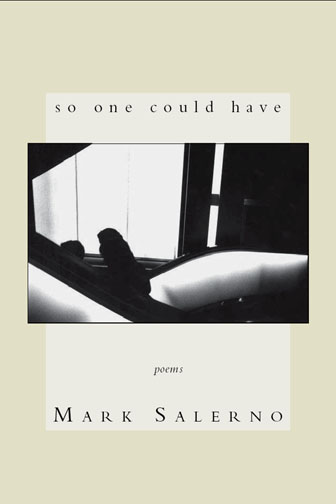
A review of
So One Could Have by Mark Salerno
ISBN 1-888996-86-2
In Mark Salerno’s latest book of poetry, So One Could Have, the
details pile up like the moments of an extraordinary day. What we have in this book is a casually scientific exegesis on the passage of time. In lesser hands this tall order might have become an exercise in tedium, but Salerno pulls this off in a most deceptively simple, and likable way.
Any given day, for most denizens of planet earth, is a harried series of moments. The challenge is to not only move through life with aplomb and accomplish something but also to add up these moments and decipher any supposed meaning. The relative aspect of human existence aside, good art is unflinchingly good at representing some facet of communal reality—without moralizing. This said reality may be represented as completely irrational and fantastic, banal and predictable, or somewhere uniquely in between, the skill lies in recording it faithfully and then stepping aside. Salerno is a subtle master of stepping aside. One thing that makes this book so interesting is Salerno’s use of caesura.
I used to be feeling now I am a penny arcade
(from “Small World,” p. 27)
These are poems that use monolithic pauses to accentuate and ground. Nearly after each observation comes a forceful void, which outlines the music of these lines like a Mondrian. Not that these poems are rigid or forced, they are in fact very fluid and faithful to the seemingly liquid quality that consciousness has. In “Pink’s” (p. 59) Salerno states
In seeing one thing we probably see many
wherein I gathered all my passing moments
to reconstruct a bibelot and a merely stupid
O befuddled longing O track of wonder
Salerno does seem to see many things at once and his poetry allows the reader to experience a similar luxury. This book is a photo lab of discrete stock-piled images. Salerno seems to instinctively know how to post-modernly question what most have accepted as foundations of Western humanism with the nonchalance of sleight-of-hand man.
we awake as good as another from dreams
I hate that Picasso and Newton screwed up
science and the Renaissance was a mistake
I love the light before the blue and the
time it takes to be here it is the role
(“Small World,” p. 27)
Salerno’s reticence is not overpowering, however. It seems to be more of beginning than an ending for him. His dispassionate attitude seems to be more of a harnessing of power and a summing up rather than a giving up or a defeat. These poems lie somewhere between despair and celebration in a middle ground that is somewhat mysterious. The inversion of thought and image in some of Salerno’s best lines lends his poetry in this volume a somewhat cinematic quality.
she said nice little town you got here
sheriff with eyes on the stranger logic
wanted the big hit the big grab and skip
over the border it’s a helluva country
to be modern in cottonwoods and damp cuffs
a building falls down but the sky stays put
(“Coda,” p. 69)
There is a disheveled beauty in the immediacy of this book, but the downside of that is sometimes this reviewer felt perhaps some of these lines rely a bit too much on the journalistic impulse. Usually, at these moments in So One Could Have, however, the poet’s idiosyncratic method serves to bring the reader quickly back around—whatever slack or uninteresting strophes are compensated for by another apt turn of phrase which surely follows.
This ebb and flow in Salerno’s new book provides a real sense of what is true of human consciousness. Existence entails a constant process of redefinition. This book achieves that superlatively.
Tuesday, January 16, 2007

Miracle of Apples
Someday the apples will be liberated, the pear
will start a revolution and the banana will
commit suicide, rather than be executed. In tense meetings,
the cantaloupe has come up with a new political system.
It exists at the center of an ovoid universe, on a long summer afternoon.
You dream of secret conversations that drip with sticky, pink juice.
Yesterday, the pomegranate gave a speech and received a
rousing ovation.
But at midnight, patrols of vegetables rode through town,
plastering posters of the banana on every available wall.
Grapes everywhere were deceived into joining the
knives, forks, dishes, mugs, and even a glass of wine.
Now dinner has descended upon me.
They will lead me to my ordinary death,
as real as the breath of a cannibal.
will start a revolution and the banana will
commit suicide, rather than be executed. In tense meetings,
the cantaloupe has come up with a new political system.
It exists at the center of an ovoid universe, on a long summer afternoon.
You dream of secret conversations that drip with sticky, pink juice.
Yesterday, the pomegranate gave a speech and received a
rousing ovation.
But at midnight, patrols of vegetables rode through town,
plastering posters of the banana on every available wall.
Grapes everywhere were deceived into joining the
knives, forks, dishes, mugs, and even a glass of wine.
Now dinner has descended upon me.
They will lead me to my ordinary death,
as real as the breath of a cannibal.
Lifer
Just listen at your
center for and
if the whir there
comforts drift
upon thought.
Small compasses
we were as if
but then catch
seeming shadows
above else.
Enormous burn
upon waves we
sift blisters as if
life were unnoticed.
Perception’s nexus
ices my afternoons
with more questions.
center for and
if the whir there
comforts drift
upon thought.
Small compasses
we were as if
but then catch
seeming shadows
above else.
Enormous burn
upon waves we
sift blisters as if
life were unnoticed.
Perception’s nexus
ices my afternoons
with more questions.
I’ve always found the art of Jean Dubuffet very interesting because of its seemingly primitive qualities. The adage “you have to know the rules to break them” really does apply in this circumstance, however, because in Dubuffet’s work, the childlike, simplistic nature of each piece eventually leads the viewer to reconsider what it is he or she is looking at and to rethink how our perception of a particular object exists in reality and in the abstract. This end is the result of effective process. When you think of the words “table” or “chair” it may very well be that a specific table or chair from memory comes to mind, but it’s more probable that one thinks of a nebulous, abstract idea of a table or chair. We’re transported by viewing art, and it’s the transformation that matters. Dubuffet’s work doesn’t rely on the Romantic notion of the sublime, however. He’s used a different sort of aesthetic barometer entirely and that’s what make his work so original, I think. There is an expressionist quality to his work but no attempt to create something that is stereotypically beautiful, (i.e., it ain’t easy on the eyes). So, many viewers are probably left puzzled when they find they aren’t attracted to his art. Dubuffet has left the process open to interpretation and obviously valued the act of creation over concern for the end product. That’s not to say he wasn’t probably very meticulous in the creation of each object, he simply moved beyond the tendency to fool the viewer into believing that what is being seen in any way resembles reality.
Subscribe to:
Posts (Atom)